I am now more than two-thirds of the way through the semester, so I thought it would be appropriate to share some of my experiences as a gastprofessorin (guest professor) at the University of Applied Sciences here in Karlsruhe. This trip has been more than three years in the making and I want to start by thanking some of the people who made it possible.
First, I need to thank Mercer University and Dean Wade Shaw for giving me the opportunity to go on sabbatical. I submitted my sabbatical proposal three years ago and was fortunate to get approval from the University to use the Spring 2012 semester to teach at Hochschule Karlsruhe University of Applied Sciences (HsKA). I also need to thank my colleagues at Mercer, Drs. Marj Davis, George Hayhoe, and Susan Codone, for their support during my absence. In particular, I owe a debt of gratitude to George, who took over as Department Chair while I was here.
Second, I need to thank the faculty and staff as HsKA. Four years ago, Dr. Joachim Lembach, Director of HsKA's International Programs, invited me to give several lectures to the HsKA technical communication faculty and to begin the process of establishing a cooperative agreement between Mercer and HsKA. Due to his efforts, and those of Professor Sissi Closs, such an agreement was reached, an HsKA student came to Mercer to study in 2010, and I was invited to become a gastprofessorin in 2012.
Lastly, I need to thank Art for his love and support. Side by side, we have experienced the challenges and opportunities presented by living in a country where we do not speak the language, have laughed (and sometimes cried) at the various turn of events, have traveled extensively (as you have seen by the entries on this blog), and have had the experience of a lifetime. Without him, this sabbatical would have been a very different, and very lonely, adventure. I love you, Art.
The rest of the blog is organized as follows: an overview of HsKA, then the Technical Communication Department (Technische Redaktion), the students and faculty, and finally some of the challenges and rewards of teaching here.
 |
| The Hochschule Karlsruhe has ~8000 BS and MS engineering students. The campus is located in downtown Karlsruhe and, like most German universities, has no dorms, so all students live off campus and commute (some for more than an hour, usually via the train/tram system). There are over 35,000 students in Karlsruhe; 20,000 of whom attend the Karlsruhe Institute of Technology, which is within walking distance of HsKA. Needless to say, apartments are at a premium here. This is the entrance to the HsKA campus. |
 |
| Like Mercer, the mission of HsKA is to educate practicing engineers. Students have a very rigid curriculum, with no liberal arts components. Each student must complete a five-month internship in industry, and most students work while they attend school. Students do not pay tuition, just minimal student fees. The campus is small and compact; bicycles abound. |
 |
| All faculty teach a minimum of 6 courses/semester, and many teach more than that (as opposed to our 3 course/semester load at Mercer). Faculty also consult with industry and many have lucrative consulting businesses on the side. Each engineering faculty member has a well-equipped lab (one show here), with state-of-art equipment provided either by the government or industry. |
 |
| No German university has a collegiate sports program like we experience in the US. Most on-campus activities at HsKA are related to some kind of engineering competition. Pictured here is the school's entry into the European mini-Formula One competition. |
 |
Here is the campus cafeteria. Food is good (and relatively inexpensive). Local high school students eat here as well.
The Technical Communication Department
|
 |
| The Department of Technical Communication has ~250 BS and MS students and 8 faculty members. Like the engineering curriculum, the BS curriculum is also fixed, and BS students take 6 semesters (6 courses per semester) and a one-semester internship. The demand for TC students here is strong; many work part-time while attending school and find lucrative positions with local companies such as Siemens when they graduate. The program here is one of the most successful TC programs in Europe. |
 |
| The Tech Comm offices/classes are located in a modern office building about 10" from the main campus. The classrooms and faculty offices occupy the first and third floors. |
 |
| My teaching load consisted of 6 courses. I taught two graduate classes, one in how to do research (to prepare the MS students for their master's thesis work) and the other on international tech comm (to prepare the students to work in a global environment). |
 |
Here are four students from my grad research class. This picture was taken at a tekom conference, where they were volunteers. I have been really impressed by the students' dedication to their studies, their work ethic, and their ability to balance their graduate studies with the demands of their jobs (they all work at least part time and many commute by train for at least an hour to get to class).
|

Students are addressed by their last names, but since I couldn't pronounce many of them, we all agreed that I could use their first names. I would not let them call me Professor Dr., so we settled for Dr. Grady. At the end of my first lecture to my graduate students, they all rapped on the desks with their knuckles. When they saw my amazement at this activity, they explained that they do this after every class. Soft rapping means they didn't care for the lecture; lots of noise means they liked it and learned a lot. I think I will try and institute this custom at Mercer. It's a great way to get immediate feedback on the lecture content and delivery! |

|
| My four undergrad courses consisted of two sections of a course to teach the students how to edit technical documents translated into English (a big issue here is Germany) and two sections of a course on intercultural communication (focusing on how culture impacts how people write and speak, especially in a business environment). These are students in my tech editing class. |
|
 |
I delivered all my lectures (90" each) in English and the students made all their presentations in English as well. Most students spoke English very well; however, their oral communication skills were better than their written skills. And, they all certainly had a better grasp of English than my grasp of German. They had lots of fun translating German expressions for me. Very often, they would turn to each other to ask how to express a German word in English, which resulted in lots of laughter on their part and on mine. These are students in my intercultural communication class.
Faculty and Activities
|
 |
| tekom is the European equivalent of the Society for Technical Communication. The regional conference was held in Karlsruhe in March. I cancelled classes that day so the students could attend (or work there). |
 |
| Sissi Closs (pictured here), is a founding professor of the tech comm program. She also owns a tech comm consulting business with over 60 employees and commutes from Munich (~3 hours by train) at least one or twice a week to teach classes in Karlsruhe. |
 |
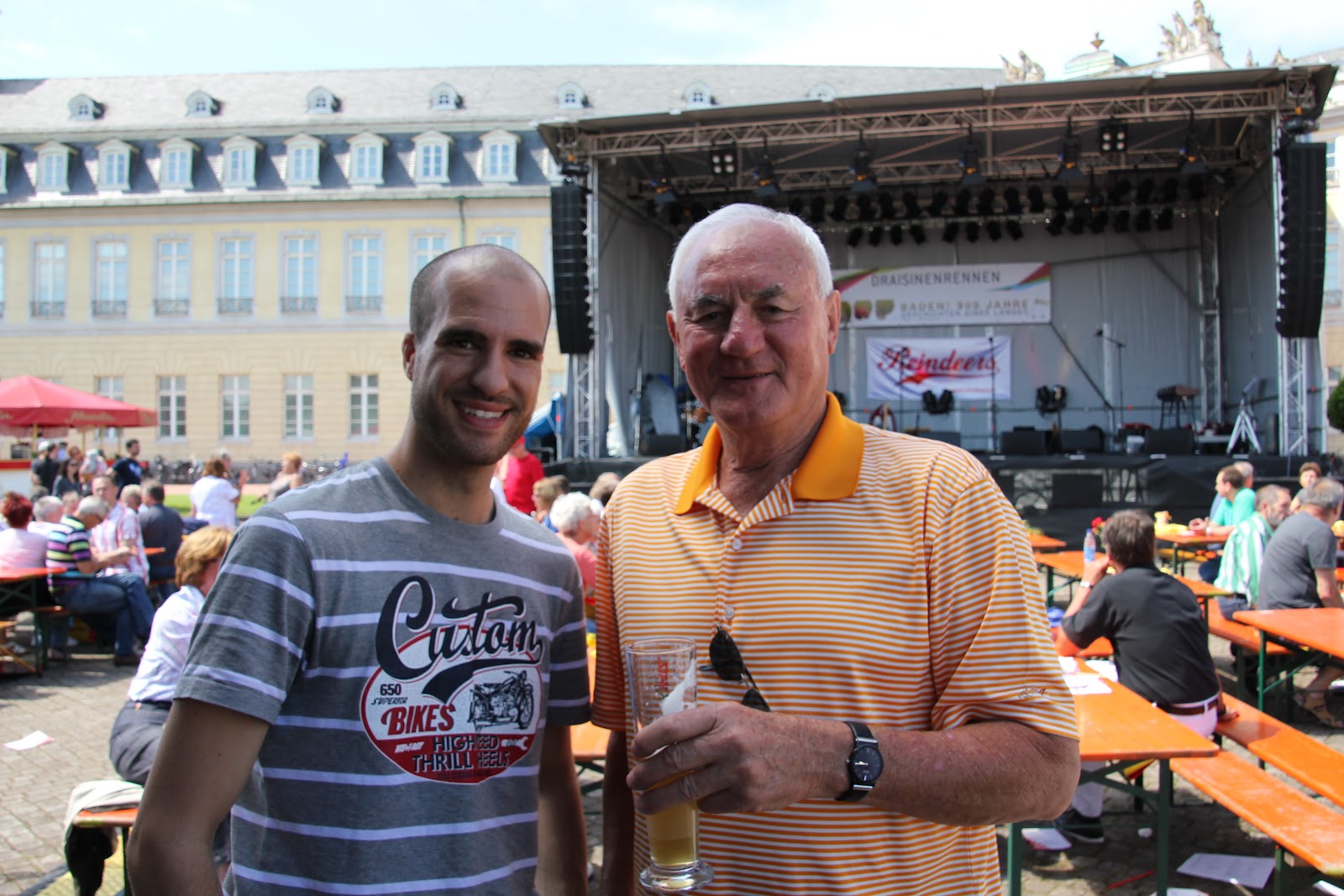
One of my students, Jan, and his partner won the tekom competition for most creative technical innovation in technical communication (and the prize of 2500 euros). Jurgen Muthig, also pictured here, is the president of tekom and the other founding professor of the tech comm program. (Small world note: Jurgen and I sat together at the STC President's table during the awards banquet in Chicago in May when I was inducted as a Fellow). |
 |
| Jurgen has been an invaluable colleague. He and his wife, Rebecca, have become good friends and we have had dinner together on several occasions. Here they are in their kitchen, preparing a wonderful meal which we ate in the garden with their three boys. |

|
| Dr. Dieter Hoepful is the Provost of HsKA(far left and proud owner of this 1960s VW convertible), Dr. Joachim Lembach is the Director of the International Programs Office, and responsible for my initial invitation to visit HsKA four years ago, and Sissi Closs, who was instrumental in creating my visiting professorship position. Here we are after dinner at a local restaurant, the Gutenberg. This is also the local of the Gutenberg Platz, which we love to visit on Saturdays when the local meat, cheese, bread, and vegetable vendors come to market. |
Rewards and Challenges
Teaching at HsKA has been an incredibly rewarding experience and I am very fortunate to have had the opportunity to interact with a wonderful group of students and faculty for the last five months. One of the best aspects of this experience is that I was able to concentrate on teaching and working with students because, for the first time in 20 years, I had no administrative responsibilities. It was a real pleasure to create new lectures and different assignments for my various classes. As always, I learned more from the students than they did from me. These students were as equally motivated and dedicated as my Mercer students and, once again, I am reminded that I am so fortunate to work with such gifted students.
The challenges I faced here were of my own creation, either because I was deficient in some area or I had expectations that were unrealistic. Two challenges in particular are worth reflecting on. First, I was not expecting nor was I prepared to deliver six 90" lectures per week. Students here do not buy textbooks; faculty deliver the material to be learned via their lectures, then assign the students projects, most of which are in conjunction with local industry so the students can convert the theory into practice. In our tech comm dept., we assign the students readings from textbooks or current literature and expect that the classroom time will be devoted to discussing the concepts. We also assign students real-world problems so they can convert the theory into practice as tech comm is an applied degree, but not many projects are as closely integrated with solving industry problems. So, I spent many hours writing lectures and creating short projects that the students could complete in class. Challenging--yes, but I was able to do a lot research on current theory and practices in tech comm to create these lectures, which I can now share with my Mercer students. So, it was a blessing in disguise.
 |
| Here is the hallway leading to my office, last door on the left. |
The second challenge I faced was getting used to working behind closed doors. Doors to all offices are always closed, even when the faculty are working in them, as are the doors to all classrooms whether or not a class is in session. (As I learned when I went to get my residency permit, it is typical in Germany for all employees to work behind closed doors.) And, coming from the very collegial work environment at Mercer, I felt a little isolated as the HsKA tech comm department is not on campus, so I had little opportunity to interact with other faculty. All in all, small challenges to deal with given the wonderful opportunity to work with such dedicated faculty.
 |
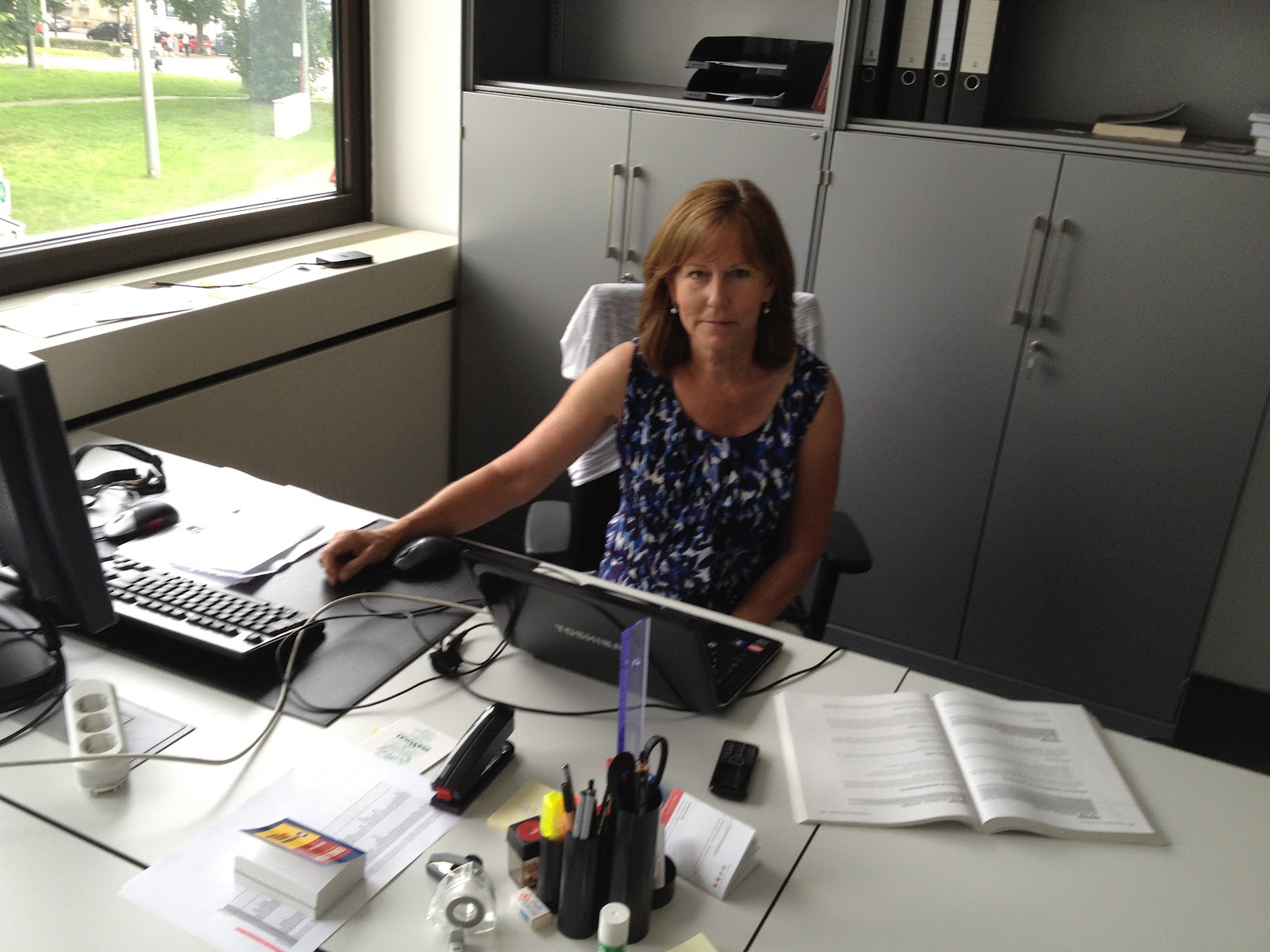
| One advantage to working behind closed doors is that you can have a messy office! And, no one can hear your !#$%^ when you make lots of typos because the German keyboard that has the z and y keys interchanged and lots of other characters that we do not use in the U.S. |
 |
| In retrospect, I have a renewed appreciation for the opportunities that a degree in tech comm gives students and a deeper understanding of the contributions technical communicators can make in the global workplace. I will return to Mercer refreshed and with a variety of experiences that I can share with my graduate and undergraduate students. I am truly blessed! |